

An easy guide to the charges, legal costs and considerations that shape your journey from purchase to ownership.
Buying a home is often discussed in terms of the property price, but the purchase price is just one part of the financial commitment. For potential buyers considering a second home or a long-term investment, the real cost of ownership starts even before the keys are handed over.
- Stamp duty
- Registration Charges
- Legal due diligence
- Documentation expenses
All of the above form part of the transaction; understanding this early is not simply about budgeting accurately, but about making a more informed decision. And for those researching stamp duty and registration charges in Goa, clarity matters. These costs can vary depending on the nature and value of the transaction

The Cost Beyond the Home
Every property transaction has multiple layers, the first being the home itself, including important factors such as:
- Location
- Design
- Land
- Amenities
- Long-term potential
The second step is making the ownership legally secure, which includes:
- Government charges such as stamp duty and registration fees formalise the transaction.
- Legal fees and due diligence help verify what is being purchased.
- Whether the ownership history and documentation are in order
When seen this way, these are not simply additional expenses; they are part of the infrastructure of ownership. For affluent buyers, HNIs, and UHNIs, especially those considering a second home purchase from another city or overseas, the distinction is even more important. A well-managed transaction offers something more valuable than administrative convenience: confidence.
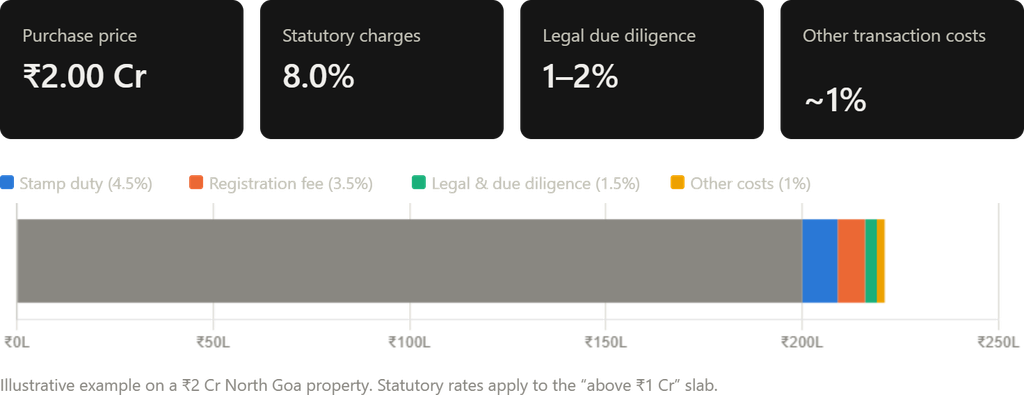
Stamp Duty: The Largest Additional Cost
Stamp duty is typically the most important statutory cost beyond the property price. Simply put, the Government levy paid on the transaction to give legal validity to the transfer of the property. The cost is generally linked to the value considered for the transaction, subject to applicable rules and regulations.
Stamp duty rates in Goa depend on several factors such as the value of the property and the category of the purchaser. Hence, buyers should avoid relying on a broad percentage heard during the initial stages of property search and instead obtain a transaction-specific estimate before processing. The more pressing question is not, ‘’What is the stamp duty rate?’’ but rather, ‘’What will be my total outlay by the time ownership is legally transferred?’’
This shift helps buyers assess the property as a complete investment rather than only looking at its quoted value.

Why it matters
Stamp duty is often seen as a cost to be calculated at the end of the process; in reality, it should be considered at the very beginning. When planning a property purchase, setting aside a separate transaction-cost buffer can prevent last-minute adjustments to liquidity or financing.
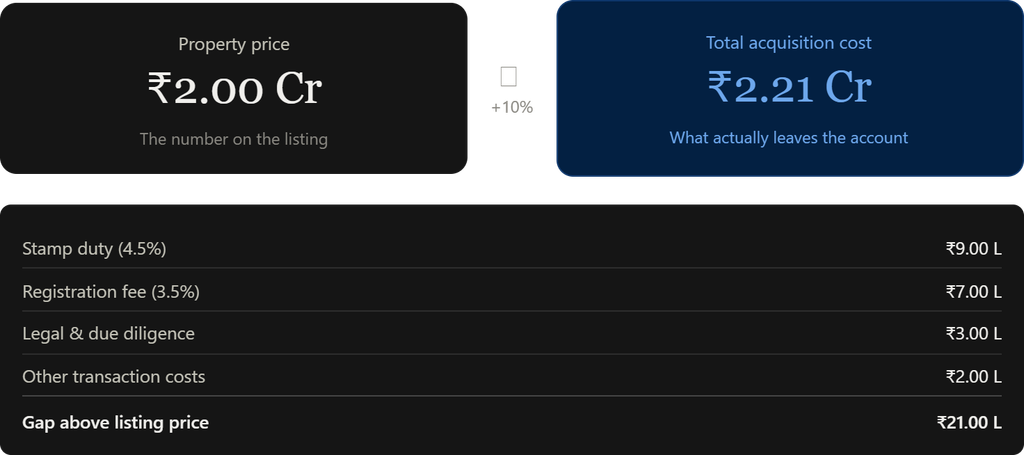
Registration Charges: Making Ownership Official
Once the relevant documentation is ready and the transaction is close to completion, the property must go through the applicable registration process. Registration creates an official record of the transaction and forms an essential part of establishing legal ownership. The process may involve submitting the required documents, verifying the details of the parties involved, paying the applicable charges, and completing formal registration with the relevant authorities.
For potential buyers, especially those unfamiliar with the local process and regulations, this can appear unnecessary. But it is one of the most important steps in the entire process. The agreement may state the intention to transfer the property, but registration helps make the transfer official. Property registration charges in Goa should be viewed alongside stamp duty, rather than as an afterthought. Together they form a very important part of the statutory cost of acquiring a property.
| Stage | Typical duration |
| Booking | ~7 days |
| Agreement | ~14 days |
| Documentation | ~21 days |
| Stamp duty | ~3 days |
| Registration | ~1 day |
| Mutation / Ownership | ~30 days |

Legal Fees and Due Diligence: Paying for Peace of Mind
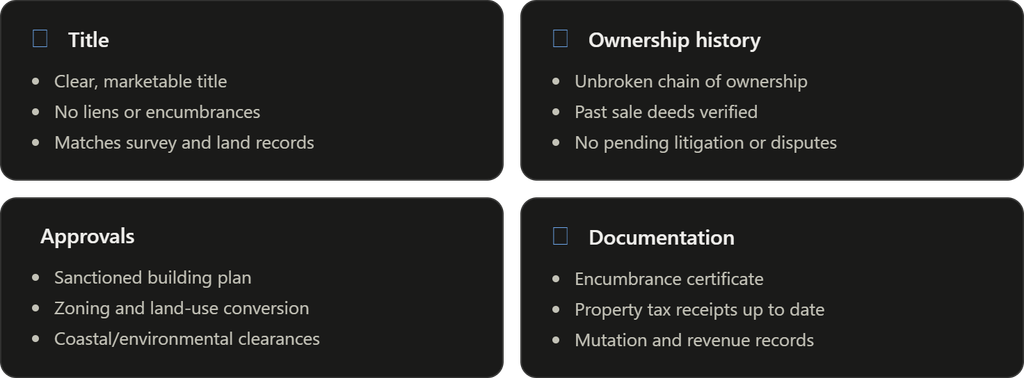
Some of the most important costs in a property transaction are not paid to the government. Legal due diligence is where buyers verify the property before committing to the purchase. This depends on the transaction, and it can include:
- Reviewing title documents
- Ownership history
- Permissions
- Approvals
- Other relevant documents
A legal professional may assist with reviewing agreements and identifying potential issues before the transaction is completed. These legal costs for buying a property in Goa can vary depending on the complexity of the transaction and the scope of the work involved. It may be easy for one to view legal due diligence as an area to ignore, but for a high-value property purchase, this is often where careful spending can protect a much larger investment.
The purpose is not to make the process more complicated; it is merely to reduce uncertainty. A well-executed due diligence process allows a buyer to move forward with a clearer understanding of what exactly they are purchasing and the documentation supporting that ownership.
The Smaller Costs That Can Add Up
Beyond stamp duty, registration and legal fees, there will be other additional costs when buying a property in Goa. This can include:
- Documentation expenses
- Agreement drafting
- Notary charges
- Professional fess
Depending on how the property is being purchased, buyers may also need to consider:
- Loan processing and related financing charges
- Brokerage, where applicable
- Applicable GST for certain under-construction transactions
- Ongoing costs such as property tax and maintenance after purchase
Individually, some of these costs may appear modest. Together, they can influence the final budget. And this is particularly relevant for second-home buyers; the purchase is not a one-time transaction. It marks the beginning of ownership, which includes its long-term financial considerations.
A more complete financial view therefore looks beyond acquisition and asks: What does it cost to buy, own and maintain this home over time?

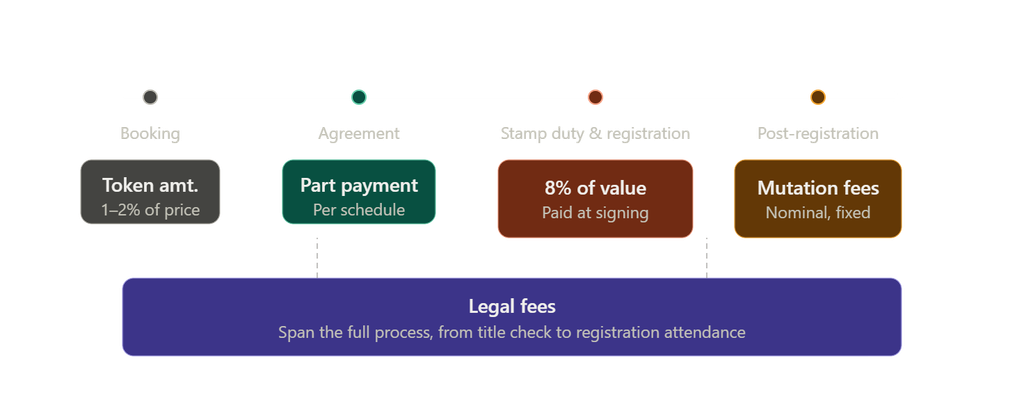
When Do You Pay What?
Understanding the timing of transactions is as important as understanding the reason for them. At early stage, the buyer may pay a booking amount or an initial consideration as outlined in the transaction. At the agreement stage, documentation and legal review become increasingly important.
Closer to registration, statutory charges such as stamp duty and registration fees generally become central to the completion of the transaction. The exact sequence will depend on the structure of the purchase. But the broader principle remains the same: costs are distributed across the ownership journey. Planning all of this allows buyers to manage their liquidity more effectively and avoid treating high costs as unexpected additions.
Thinking Beyond the Transaction
The smartest property decisions are rarely based on the headline price alone. A home can be different for everyone: an investment, a second home, a space for family and friends, or a way of spending more time in a location one feels connected to. Regardless of the reason for the purchase, the transaction should begin with a complete understanding of the commitment involved.
The real property cost is broader than the purchase price. It includes multiple costs: acquiring the asset, securing legal ownership, and preparing for the responsibilities that follow. For buyers, the process need not be intimidating but rather crisp and clear for them to be able to make decisions with confidence.
At The Chapter, the buying journey is designed around making the process feel clear and simple, with structured guidance available at every step of ownership and documentation.

Clarity Is Part of Smart Ownership
Stamp duty, registration charges, and legal costs are unavoidable parts of a property transaction, but they should never feel like hidden costs. Understanding the local process in Goa for stamp duty and registration lets every buyer evaluate the actual cost of the purchase. Plan their finances and approach the process with greater confidence. And for a significant investment, transparency is not simply good administration; it is a part of the process. The best ownership journeys begin when everything important is clear: financially and legally.