
An overview of the legal, regulatory, and ownership considerations that experienced buyers look at before making a decision.
Goa has long been one of India’s most desirable second-home markets. Buyers are drawn to its landscape, slower pace and distinct architecture. Unlike a conventional urban home purchase, Goa involves a deeper understanding of the land, history, planning and ownership.
Many experienced buyers say the same thing: in hindsight, the questions are rarely about the home finishes, views or location. The main concern is what sits beneath the surface, how the land has changed hands over time, what is legally permitted to be used for, and whether the property can support the life the homeowner imagines.
The legal risks of buying a home or a property in Goa are real, but they are also manageable when approached with the right knowledge and professional guidance. The goal is not to make the process intimidating; it is to make ownership more informed, confident, and future-ready.
Goa Is Not Just Another Property Market
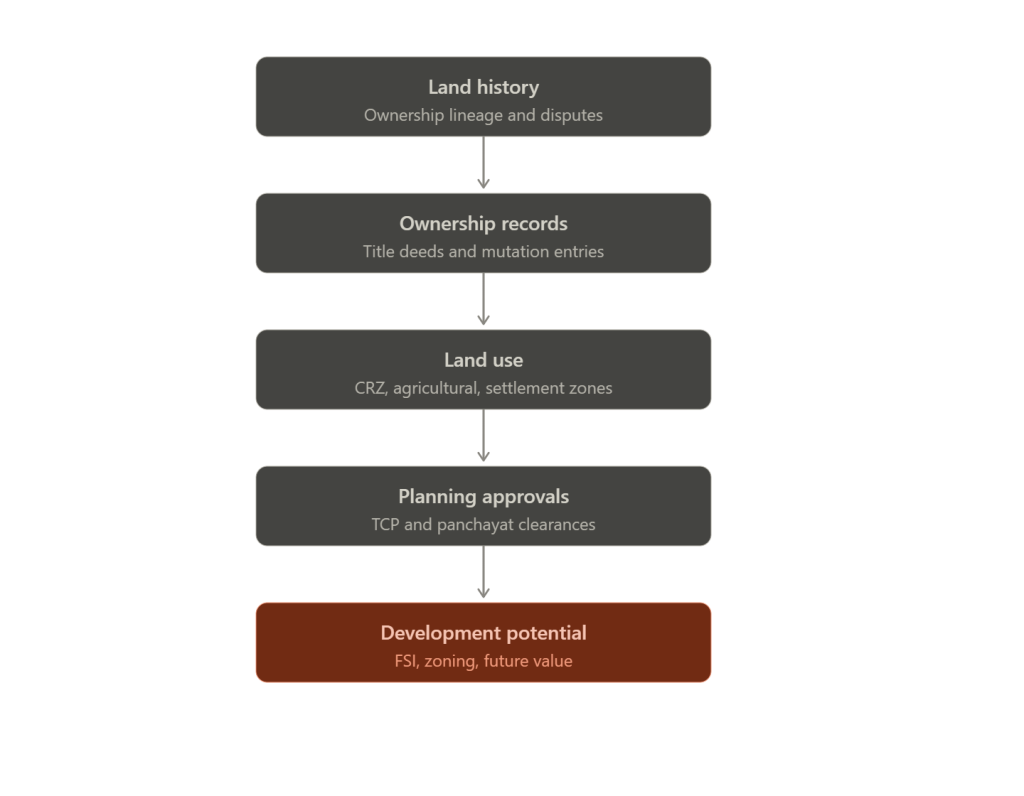
Goa requires greater attention, and due diligence due to the state’s distinctive land history. Goa’s Portuguese colonial past created property records and ownership systems that differ from those commonly encountered in other parts of India. Depending on the property, a buyer may encounter historical registration records, older ownership references, inherited land parcels and documentation that has evolved across multiple generations.
Some properties may have also passed through several generations; in such cases, the current ownership position may need to be understood alongside the broader chain of ownership and succession.

Goa’s land-record system continues to maintain and update:
- Cadastral records
- Survey information
- Mutation records
- Property Maps
Buyers can access information such as Form I & XIV records and survey details through official channels, although these records should be interpreted alongside the complete legal history of the property.
The key insight here is that a document that appears simple cannot tell the entire story on its own. For buyers accustomed to apartment purchases in large cities, this is a meaningful shift. A Goa property purchase often requires looking at several layers of information rather than relying on one ownership document or a single presentation.
When Ownership Is Not Immediately Clear
Title ambiguity is among the most common property legal issues in Goa and one that buyers may not recognise until late in the process. A property may have changed hands through inheritance, family arrangements, partition or multiple transactions. If ownership records have not been updated consistently, the relationship between the present seller and previous owner and the property itself may require closer examination.
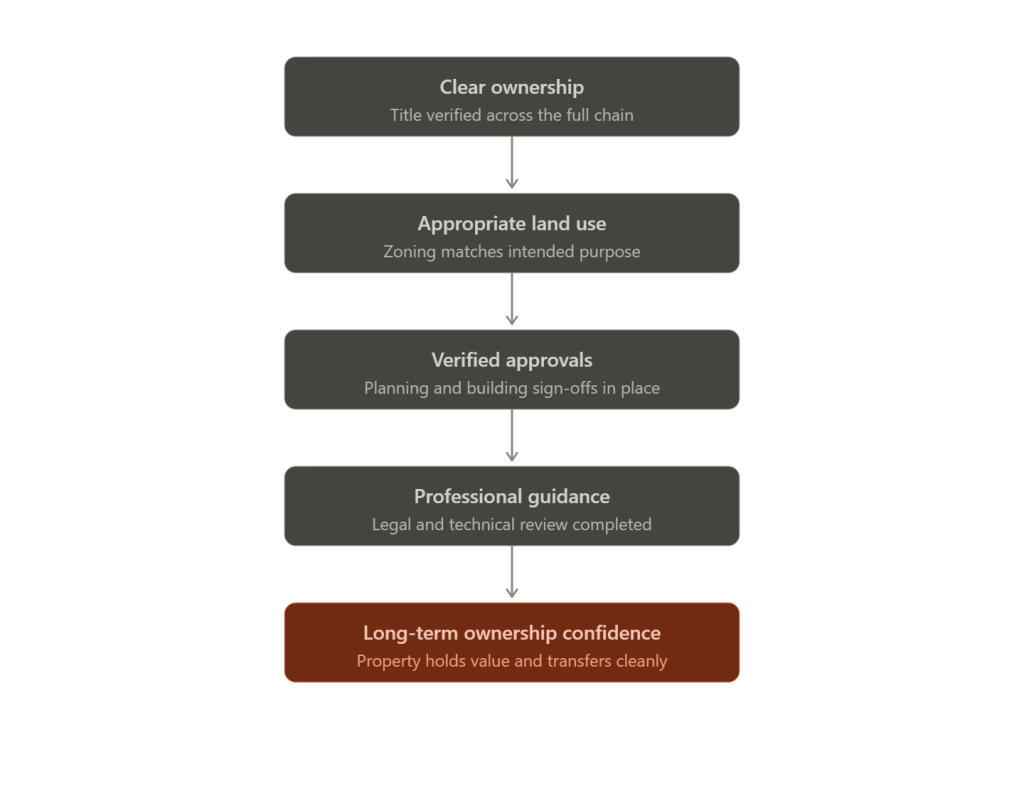
This does not automatically mean that a property in Goa should be treated as more than a procedural formality. It is the foundation on which every other aspect of ownership rests. Experienced buyers often learn that the right question is not simply, who owns the property.
Land Use Can Shape The Entire Investment
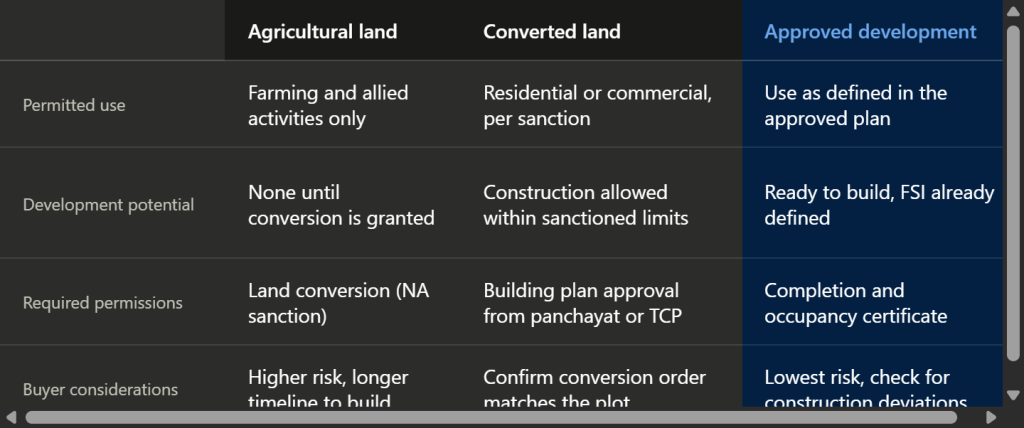
One of the most common areas of error for buyers concerns the distinction between agricultural land and land that has been permitted for non-agricultural use. This is where terms such as NA land frequently enter conversations. NA land generally refers to land that has received permission for non-agricultural use. However, the existence of a conversion document should not be used in isolation. Buyers also need to understand the applicable zoning, permitted use and development conditions for the specific site.

Goa’s Town and Country Planning Department is responsible for planning frameworks, including regional planning, outline development plans and zoning plans in notified areas. These planning frameworks influence how land may be used and developed. Land conversion itself follows a defined process and may involve records as stated below before a conversion sanad is issued.
- Form I & XIV
- Survey Plans
- Ownership documents
- Site
For potential buyers, the practical lesson is that land classification, conversion and development potential are connected, but they are not interchangeable. A plot may be attractive because of its size, surroundings or location. Yet the legal permissions may not support the scale or type of development a buyer has in mind.
Approvals Are Part Of The Ownership Experience
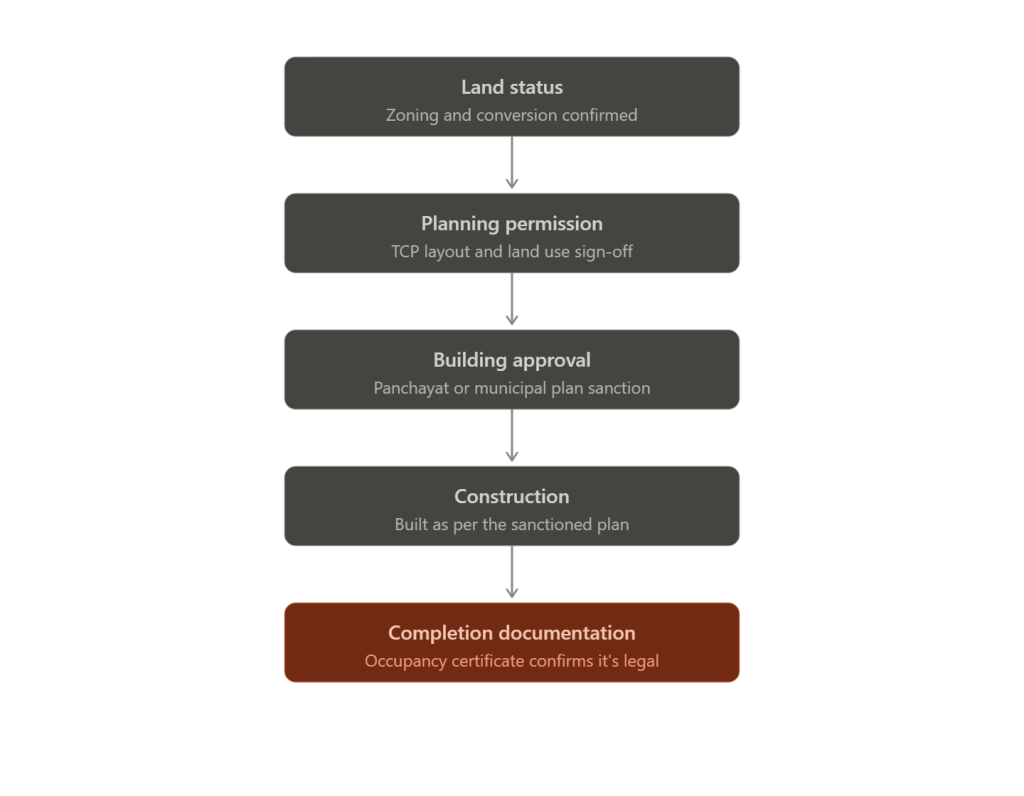
Development permissions, building approvals, construction licences and completion-related documentation all influence whether a home has been made in accordance with the applicable regulations.
The approval process may involve multiple stages and authorities depending on the type of property, its location and the nature of the proposed development. Goa’s planning framework includes separate procedures for development permissions, subdivision approvals, building permissions and completion-related requirements.
And this is particularly important for buyers purchasing land with plans to build or acquiring an existing home that has been extended or modified over time. An additional room, terrace enclosure, guest annex or structural alteration may appear to be a lifestyle enhancement. However, if it’s undertaken without the necessary approvals, it could create future compliance challenges.
The same principle applies to land with complex topography. Work involving hilly, sloping or low-lying land requires prior permission under applicable planning provisions. For experienced buyers, approvals are not merely the documents for collection. They are part of understanding if the property can be enjoyed, maintained, and transferred further with confidence.
Coastal Living Comes With a Different Set of Considerations
A home close to the sea is Goa’s most important asset; however, it does involve an additional layer of regulatory context. Coastal Regulation Zone or CRZ rules are designed to protect coastal environments and regulate certain forms of development within designated boundaries. The Goa Coastal Zone Management Authority oversees matters related to the coastal zone regulation of the state.
For potential buyers, proximity to the coastline should lead to more informed questions, not of concern but by default.

- How is the property mapped?
- What regulations apply to the site?
- Are the existing structures and proposed uses aligned with the relevant permissions?
The answers may differ from each location; however, a coastal address is not enough by itself to determine the development position of a property. This is also where local expertise becomes valuable. Understanding a coastal property needs more than measuring its distance from the water. It requires thorough examination of the specific site, its regulatory classification and its approved development history.
A Property’s Past Can Affect Its Future
A property may have an outstanding loan, a registered charge, an unresolved dispute or other obligations connected with its ownership history. These are often described as encumbrances or liabilities. For a buyer, the important insight is that ownership is not only about acquiring an asset. It is also about understanding whether any obligations associated with the asset could affect future use, financing or transfer. This is why a professional legal advisor considers the property’s ownership history alongside relevant registrations, charges, disputes and supporting records.
The process should not feel like searching for reasons to walk away. It is about ensuring that the buyer understands the complete picture before making a long-term commitment.
Why the Right Developer Can Reduce Complexity
For outstation buyers, NRIs and those purchasing a second home, distance can make legal due diligence more challenging. A buyer may not be familiar with local records, planning authorities or the practical differences between one micro-market and another. They may also be more dependent on the developer, legal advisor and wider professional team to provide clarity.
This is where developer credibility becomes especially important. A well-structured development can offer greater visibility into land ownership, approvals, documentation and the overall development process. It can also reduce the burden on buyers who would otherwise need to coordinate multiple specialists independently.
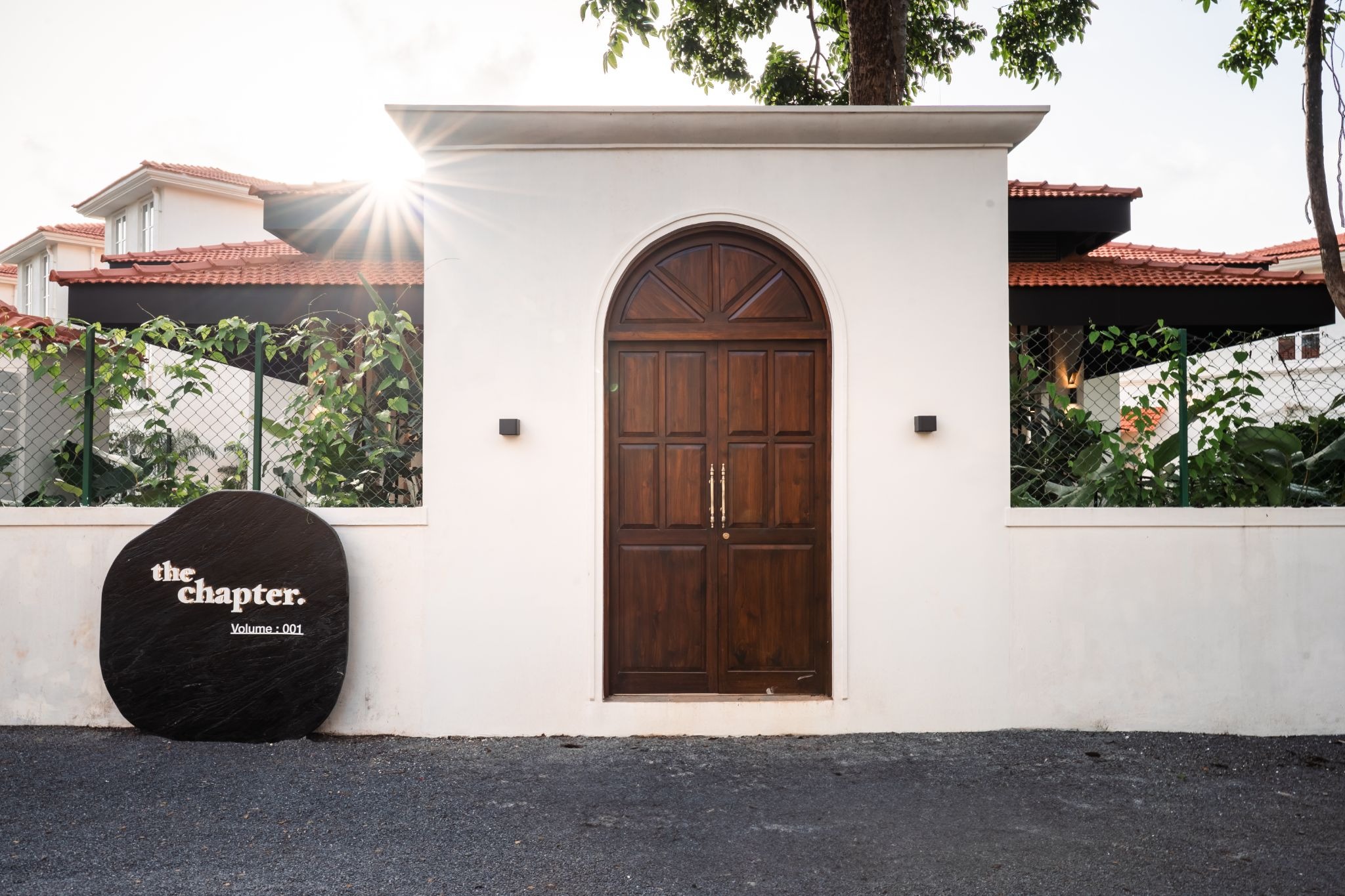
That does not remove the need for independent legal advice. However create a more transparent and organised ownership structure. In a complex market, who you buy from can matter as much as what you buy. For thoughtfully planned communities such as The Chapter, transparency, structured development and clear documentation are part of creating confidence-led ownership not uncertainty led buying.

De-Risking Ownership Without Making It Overwhelming
The most important aspect is to not become an expert in every Goa property law. It is to ask informed questions and work with professionals who understand the local context. Before committing, buyers should seek clarity on the ownership history, land classification, zoning position, development permissions, and compliance status of the property. A qualified property lawyer and relevant planning professionals can help understand how different elements apply to a specific location. For many second-home buyers, a professionally managed community may also offer greater ease. The value is not only in the home itself but in the structure surrounding ownership; from documentation and infrastructure to long-term management.
A thoughtful purchase process helps create confidence without requiring the buyer to navigate every complexity alone.
Smart Buying Is Safe Buying
The risks of buying land or property in Goa should not discourage buyers from exploring one of India’s most compelling second-home markets. They should enable a more considered approach.
The strongest investments are not simply defined by architecture, location or lifestyle appeal. They are supported by clarity: on ownership, land use, approvals and people responsible for
delivering the development. For buyers, awareness is the greatest asset.

When leal due diligence is approached early and thoughtfully, it becomes less of a barrier and more of a foundation. It allows the experience of owning a home in Goa to be shaped by confidence rather than uncertainty.
Because the best properties are not only beautiful. They are secure, compliant, and designed to hold their value; both as homes and as long-term investments.